
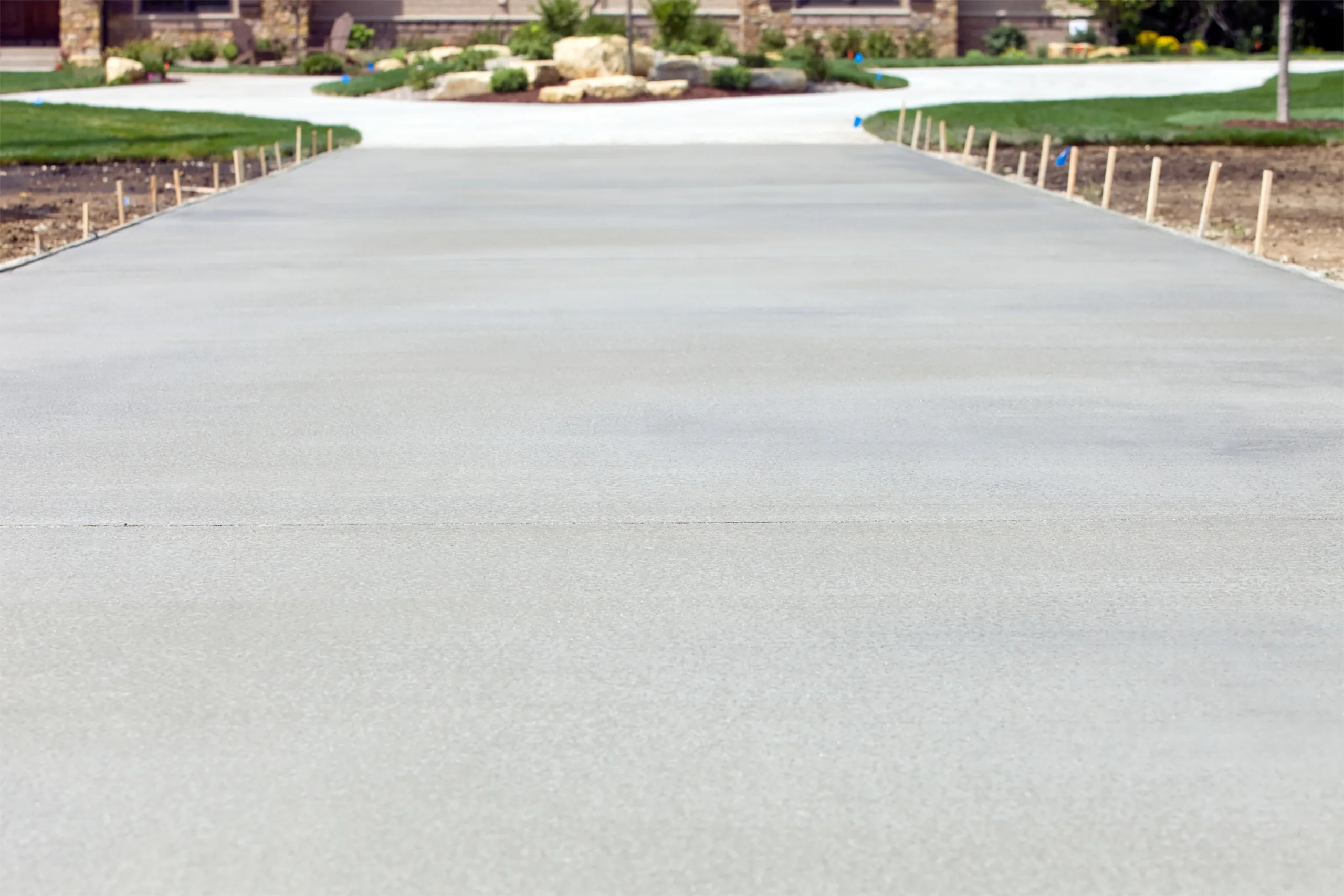
Concrete cracks.
That does not automatically mean your driveway, patio, walkway, or steps are failing.
Concrete is a rigid material placed over soil and aggregate that can move with settlement, moisture, temperature changes, and seasonal conditions. Concrete also shrinks as it cures. Proper base preparation and control joints help manage that movement, but cracking can still develop during the life of a slab.
The important question is not simply:
“Is there a crack?”
The better questions are:
- Is the crack getting wider?
- Are both sides still level?
- Is part of the slab sinking or rising?
- Does water collect around the damaged area?
- Is the concrete crumbling or breaking apart?
- Has the same repair failed repeatedly?
- Has the damage created a trip hazard?
In Central Ohio, those questions become particularly important before winter because water, freezing temperatures, and repeated freeze-thaw cycles can make an existing problem worse.
A small repair in early fall may prevent a much larger project later.
Not Every Concrete Crack Is an Emergency
When I inspect cracked concrete, I start by looking at the condition around the crack rather than judging it by appearance alone.
A narrow surface crack where both sides remain level may simply need maintenance and monitoring.
What concerns me more is movement.
I look for:
- One side becoming higher than the other
- A section of slab noticeably sinking
- A crack growing wider over time
- Several cracks spreading from the same area
- Water consistently collecting near the crack
- Concrete rocking or moving underfoot
- Edges or corners breaking apart
- Previous repairs cracking open again
The crack is often the symptom. The real question is what caused it.
Why Concrete Cracks in the First Place
There is no single cause of concrete cracking.
Depending on the project, cracks can develop from:
- Normal drying shrinkage
- Settlement of the soil or base underneath
- Poor drainage
- Erosion beneath the slab
- Temperature changes
- Freeze-thaw exposure
- Loads placed on the concrete
- Improperly prepared subgrade
- Insufficient or poorly positioned control joints
This is why filling a crack without understanding the condition around it does not always solve the problem.
If the slab underneath is continuing to move, the repair material may eventually crack again.
Control Joints Are Designed to Manage Cracking
When concrete is poured properly, contractors often create planned joints or saw cuts in the slab.
These are commonly called control joints or contraction joints.
The purpose is to provide a planned location where shrinkage and movement can occur instead of allowing an uncontrolled crack to develop randomly across the surface.
Control joints do not guarantee that a slab will never crack elsewhere, especially on larger slabs or when the base underneath moves.
But when I inspect concrete, the location of a crack in relation to the joints can provide useful information about what the slab has been doing over time.
Why Concrete Cracks Matter More Before a Central Ohio Winter
Concrete is porous, and cracks create another pathway for moisture.
When water enters a crack or saturated concrete and then freezes, it expands.
Repeated freezing and thawing can place additional stress on already weakened concrete and contribute to:
- Widening of existing cracks
- Surface scaling
- Spalling or chipping
- Larger pieces breaking from edges
- Further deterioration around damaged areas
This is why I recommend inspecting concrete before freezing temperatures become routine.
You want enough time to identify a problem, decide what type of repair is appropriate, and allow repair materials to cure under acceptable conditions.
Our Central Ohio fall home maintenance checklist follows the same philosophy throughout the home: inspect before winter conditions turn a manageable maintenance issue into a harder repair.
Look at Both Sides of the Crack
One of the simplest observations a homeowner can make is whether both sides of a crack remain at approximately the same elevation.
A crack can be relatively narrow but become more concerning when one side has risen or settled enough to create an uneven surface.
That difference tells me the concrete may not simply be cracking—it may be moving.
On a walkway, driveway, patio, or step, vertical displacement can also create a trip hazard.
At that point, the project deserves more attention than a cosmetic crack.
Water Pooling Near the Crack Is an Important Clue
When inspecting concrete, I pay close attention to drainage.
Ask:
- Does rainwater collect in this location?
- Does a downspout discharge nearby?
- Is the slab sloped in a way that traps water?
- Does water disappear beneath the slab?
- Is nearby soil washing away?
Water can contribute to erosion or weakening of the base underneath a slab.
If the support underneath changes, the concrete above can settle or move.
Sealing the visible crack while ignoring a drainage problem may therefore treat only the symptom.
Hairline Cracks Can Often Be Maintained and Monitored
If the crack is small, stable, both sides remain level, and there is no evidence of significant movement underneath, a relatively simple crack repair may be appropriate.
The damaged area should first be cleaned and prepared according to the repair product being used.
The goal is to keep debris and moisture out while monitoring the concrete for future movement.
I recently repaired a small chip in a concrete walkway about the size of a golf ball.
The damage was localized and did not indicate that the entire walkway needed replacement.
A small repair was appropriate—and much more economical than allowing the opening to remain exposed through another winter.
Deeper Cracks Require More Preparation
A wider or deeper crack may require more than squeezing repair material over the top.
Loose material, dust, and deteriorated edges need to be removed so the repair can bond to sound concrete.
Depending on the repair, preparation may involve mechanical tools such as a grinder or other concrete-preparation equipment.
That process can generate significant silica-containing dust, so appropriate dust control and personal protective equipment are important.
The repair material itself must also be selected for the particular application, depth, exposure, and expected movement.
There is no universal concrete patch that is appropriate for every crack.
Chipped Corners and Edges Need a Different Approach
When the corner of a step, walkway, or slab breaks away, repairing the shape can require forming the edge before placing repair material.
The repair mixture must be appropriate for vertical or formed repairs so it can remain in place while curing.
The surrounding concrete also needs to be sound enough to accept the repair.
Once the material begins setting, the finish can be shaped to blend with the existing concrete as reasonably as possible.
But again, the cause matters.
If the edge continues moving, receives repeated impact, or has widespread deterioration beneath it, rebuilding the missing corner may only be temporary.
When a Sunken Slab Needs More Than Crack Filler
If one section of concrete has settled below the adjoining section, filling the crack will not restore the elevation difference.
A professional may evaluate whether the slab is a candidate for a lifting process such as slabjacking or polyurethane foam lifting.
These methods generally involve creating access points through the slab and injecting material underneath to help fill voids and raise the settled section.
But slab lifting is not automatically the correct solution every time concrete settles.
The underlying cause, condition of the slab, drainage, soil, amount of movement, and surrounding structures all need to be considered.
What If the Concrete Is Rising Instead of Sinking?
A raised section requires a different diagnosis.
Before treating the surface, determine why the elevation changed.
Possible contributing conditions can include:
- Freeze-related movement
- Expansive or changing soil conditions
- Tree roots
- Drainage issues
- Movement in adjoining concrete
For modest elevation differences, a qualified concrete professional may sometimes consider grinding or another corrective method to reduce a trip edge.
However, removing material from the surface does not correct an underlying movement problem.
If the slab keeps rising or moving, the root cause needs to be addressed.
Sometimes the Right Answer Is Remove and Repour
There comes a point when repeatedly patching concrete stops providing good value.
If a section has significant movement, widespread cracking, a failing base, or repeated repair failure, removal may make more sense.
That process can involve:
- Breaking and removing the failed concrete
- Inspecting the soil and subgrade
- Removing unsuitable material where necessary
- Installing and compacting an appropriate aggregate base
- Correcting drainage problems
- Reforming the section
- Pouring and finishing new concrete
- Allowing proper curing
The purpose of the gravel or aggregate base is not simply to “put rocks underneath the concrete.”
It provides stable, properly prepared support and can help manage drainage conditions when designed and installed correctly.
Temporary Repair Versus Permanent Repair
Not every homeowner has the budget to perform the ideal long-term repair immediately.
I think it is important to be realistic about that.
If a homeowner has a small crack and needs an economical temporary solution, we can explain:
- What the lower-cost repair accomplishes
- What it does not correct
- How long it might reasonably be expected to serve
- What warning signs should trigger another inspection
- What the more permanent solution would involve
A temporary repair is not inherently bad if everyone understands that it is temporary.
The problem occurs when a surface patch is sold as a permanent solution to ongoing movement underneath.
Repeated Patch Failure Is a Warning Sign
If you repair the same crack repeatedly and it keeps reopening, stop treating it as an isolated surface defect.
The repeated failure tells you something is still happening.
Look for:
- Settlement
- Water movement
- Poor base support
- Seasonal movement
- Loading
- Drainage problems
- Movement from adjoining structures or roots
At that point, spending more money on another identical patch may not be the best investment.
Concrete Damage Becomes Urgent When It Creates a Safety Hazard
Any concrete defect creating an immediate safety concern should be evaluated promptly.
That includes:
- A large hole
- A badly chipped step
- A raised walkway edge
- A sunken slab creating a trip hazard
- A rocking or unstable section
- A rapidly widening crack
- Several cracks spreading from one area
- Significant pieces breaking away
The priority changes once someone can reasonably trip, fall, or step onto unstable material.
At that point, this is no longer simply an appearance issue.
Cracks Near a Foundation Require More Caution
A crack in a driveway or patio is different from a crack involving a foundation or load-bearing structure.
Trinity can evaluate and perform many residential concrete repairs, but we do not pretend that every crack can be diagnosed from appearance alone.
If the concern involves:
- Foundation movement
- Load-bearing structural elements
- Significant settlement
- Major drainage or soil problems
- Cracking that appears related to the structure of the home
we may recommend evaluation by the appropriate foundation, structural, drainage, or engineering professional.
Knowing when to involve someone else is part of responsible project management.
Be Careful With Deicing Chemicals
Winter maintenance products deserve consideration too.
Some deicing chemicals can contribute to scaling and deterioration of concrete, particularly when the concrete is already porous, damaged, poorly cured, or repeatedly saturated.
I recommend minimizing aggressive deicers where practical and selecting products that are appropriate for the specific concrete surface and its age.
Follow the concrete and deicer manufacturers' instructions rather than assuming that every product labeled “ice melt” is equally suitable for every slab.
Mechanical snow removal and traction materials can sometimes reduce reliance on chemical deicers.
Before Winter, Document the Crack
If you discover a crack but are not sure whether it is moving, create a baseline.
You can:
- Take clear photographs
- Record the date
- Measure the approximate width
- Note whether both sides are level
- Observe whether water collects nearby
- Mark the ends of the crack where appropriate
Then compare the condition later.
If the crack noticeably expands, extends, changes elevation, or develops additional branches, you now have useful evidence that movement is continuing.
Why Fall Is a Good Time for Concrete Inspection
Waiting until the middle of winter creates unnecessary complications.
Repair products have temperature and curing requirements. Frozen ground makes excavation harder. Snow and ice can conceal damage. Winter conditions can also make many outdoor repairs less practical.
An early fall inspection gives you time to:
- Identify small developing cracks
- Monitor movement
- Correct drainage problems
- Complete appropriate repairs
- Schedule larger work
- Address trip hazards before snow and ice arrive
This is why concrete inspection belongs alongside gutter, exterior drainage, deck, door, and weatherproofing checks during a preventative maintenance visit.
What Trinity Handyman Can Help With
Trinity Handyman works with an experienced concrete contractor with approximately 20 years of industry experience, allowing us to coordinate projects ranging from small concrete repairs to substantially larger residential concrete work.
Depending on the project, our residential concrete services may include:
- Evaluating residential concrete damage
- Small crack and chip repairs
- Walkway and step repairs
- Section replacement
- Concrete removal and replacement
- New residential concrete installation
- Helping homeowners determine when a different specialist should evaluate the condition
The goal is not to automatically recommend the biggest project.
It is to understand the cause, explain the available options, and help the homeowner choose a repair that makes sense for the condition, safety concern, budget, and expected longevity.
A Simple Concrete Decision Guide
Small, Stable Crack
Clean, repair with an appropriate material where warranted, and monitor it.
Small Chip or Surface Damage
Repair the damaged area if the surrounding concrete remains sound, then monitor for continued deterioration.
Crack With Vertical Movement
Evaluate why one section is rising or sinking before simply filling the crack.
Sunken but Otherwise Sound Slab
Evaluate whether slab lifting or another settlement correction is appropriate.
Repeatedly Failed Patch
Investigate the underlying movement or drainage problem before spending more money on another identical repair.
Widespread Damage or Failing Base
Consider whether removing and repouring the affected section offers better long-term value.
Foundation or Structural Concern
Bring in the appropriate specialist rather than treating it as routine flatwork repair.
The Bottom Line
Concrete cracking is common.
The crack becomes important when the condition around it begins telling you that the slab is moving, losing support, deteriorating, or becoming unsafe.
Before Central Ohio winter arrives:
- Inspect existing cracks
- Photograph and monitor questionable areas
- Compare the elevation on both sides
- Look for pooling water
- Address trip hazards promptly
- Repair small stable defects when appropriate
- Investigate repeated or expanding failures
Do not wait for another freeze-thaw season to make the decision for you.
A small repair today may prevent a larger project tomorrow—but a patch should never be used to disguise a problem that really requires a more permanent solution.
At Trinity Handyman, we believe homeowners deserve both options and context. Sometimes the responsible recommendation is a small repair and continued monitoring. Sometimes it is slab correction or replacement. And sometimes the safest recommendation is bringing in a specialist.
The right repair begins by understanding why the concrete cracked in the first place.