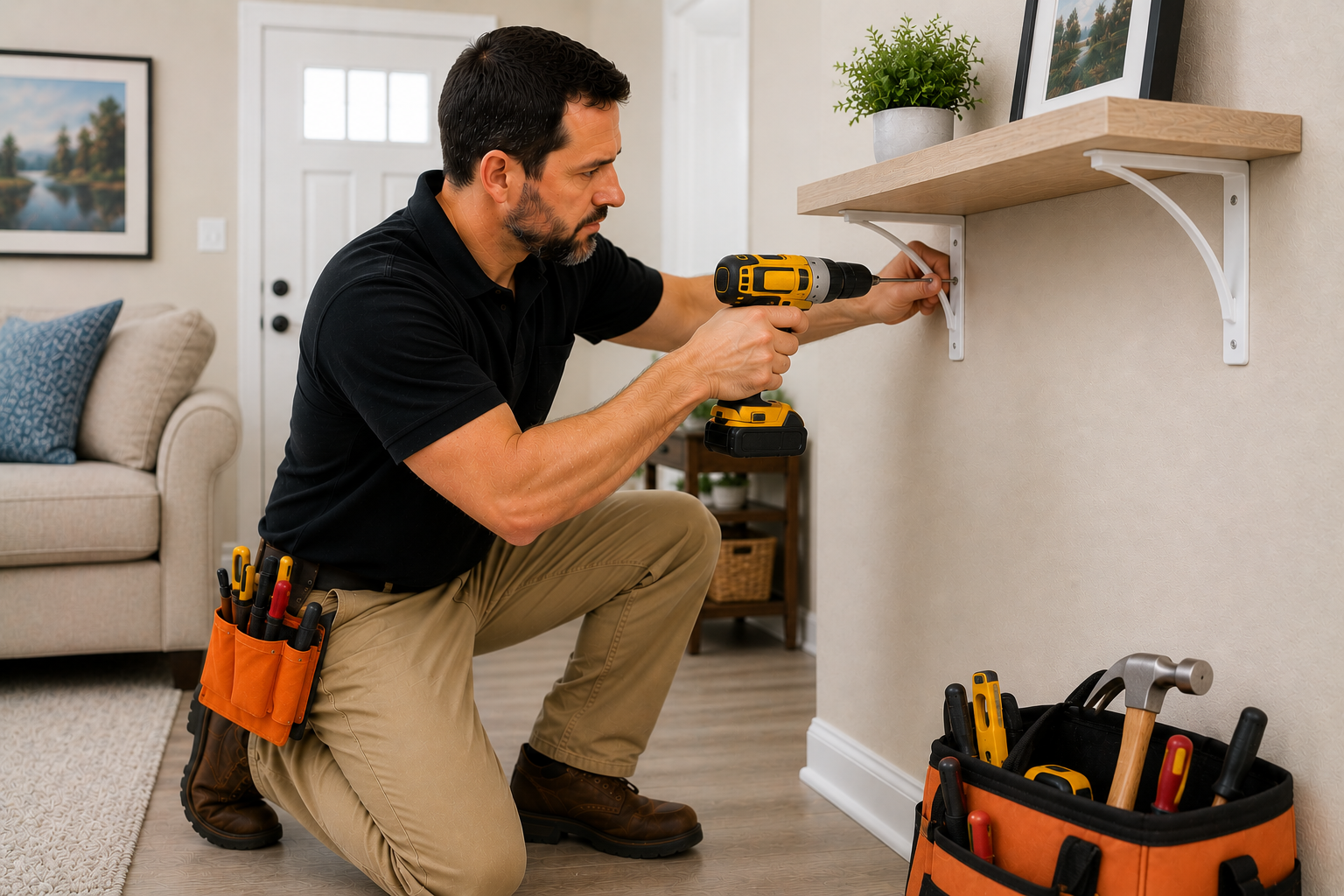
Hiring a handyman involves more than finding someone who knows how to use tools.
You are inviting a person into your home—sometimes while your family, valuables, and personal belongings are present. That makes trust just as important as craftsmanship.
A low price may be attractive, but it should never come at the cost of your safety, peace of mind, or protection if something goes wrong.
If you are still deciding where to find a reliable handyman in your area, start by gathering recommendations and reviewing local companies. Once you have a few candidates, use the following steps to evaluate them before allowing anyone into your home.
Start With Your First Impression
There is no single test that proves whether a handyman can be trusted.
Trust is usually built—or lost—through several small signals.
Pay attention to how the person carries themselves, how they communicate, whether they arrive on time, and whether they appear focused on understanding your project.
Ask yourself:
- Did they acknowledge my call, text, or online request promptly?
- Were they kind and professional?
- Did they listen carefully before proposing a solution?
- Did they pay attention to details?
- Did they explain their process?
- Did they appear customer-focused, or were they rushing to move on?
- Do they stand behind their work?
- Will I be able to reach them if a problem develops?
A busy craftsman may not be able to give you an immediate, detailed response while working at another customer's home. However, a brief acknowledgment shows that the company has a system and respects your time.
Your instincts matter too.
If the situation feels disorganized, evasive, overly aggressive, or simply fishy, do not ignore that feeling.
Remember What You Are Entrusting to Them
About ten years ago, a craftsman was working in my bathroom when my mother-in-law's medication disappeared.
That experience reinforced something I have never forgotten:
You are not merely hiring someone to complete a task. You are allowing that person access to your private space.
The cheapest quote may come from someone who accepts only cash, provides no receipt, carries no insurance, and leaves no reliable paper trail.
But what are you trading for that lower price?
Possibly your peace of mind.
Before hiring anyone, consider whether the business has taken reasonable steps to establish accountability. Ask who will actually enter your home, whether workers are screened, and whom you should contact if there is a concern.
Ask for Proof of Insurance
A trustworthy company should be willing to provide proof of insurance.
Homeowners do not plan on accidents occurring during a repair, just as they do not plan on having a kitchen fire. Yet many still keep a fire extinguisher nearby because preparation matters when something unexpected happens.
Insurance serves a similar purpose.
Do not rely solely on someone saying, “Yes, I am insured.” Ask to see documentation and confirm that the business name matches the company you are hiring.
For work involving regulated trades, also confirm that the person performing the work holds any license required for that particular service and location.
A professional handyman company should understand why homeowners ask these questions and respond without becoming defensive.
Require a Written Paper Trail
Verbal promises are difficult to prove when expectations differ later.
Everything important should be documented.
Depending on the project and how the agreement is made, the paperwork may include:
- A detailed estimate
- A written customer service agreement
- A detailed customer work order
- Business name and contact information
- Proof of insurance
- A deposit receipt
- Written payment terms
- A change order if the scope, price, or timing changes
- A final invoice
- Information about applicable cancellation rights
A detailed estimate should describe more than the general name of the project.
For example, “install and paint door” leaves several unanswered questions:
- Is the door included?
- Is hardware included?
- Is surface preparation included?
- Are paint and supplies included?
- Will scuffs caused during installation be touched up?
- Will the surrounding work area be cleaned?
The customer service agreement establishes the broader relationship and responsibilities between the homeowner and the company.
The work order should identify the specific work approved for that project.
The deposit receipt proves what was paid, when it was paid, and what the payment was intended to cover.
A written change order protects both parties if unforeseen conditions or customer-requested changes affect the scope, schedule, or price.
Documentation is not a sign that either party distrusts the other. It is one of the best tools for preventing misunderstandings.
Understand Ohio Consumer Protections
Ohio homeowners should be aware that different consumer-protection requirements may apply depending on the size of the project, where the agreement was signed, and how the sale occurred.
For certain agreements made at the homeowner's residence or away from the company's usual place of business, the homeowner may have a three-business-day right to cancel and should receive appropriate cancellation information.
Certain larger residential construction projects may also be subject to additional written-contract, payment, and change-authorization requirements.
This does not mean that every handyman project requires exactly the same forms. It means a professional company should understand which documents apply to the transaction and should be willing to explain them.
This article provides general consumer guidance and is not legal advice. Homeowners with questions about a specific contract should consult a qualified Ohio attorney.
Compare Outcomes, Not Just Prices
When homeowners receive three estimates, they often place them side by side and immediately compare the totals.
That can be misleading.
Before comparing prices, confirm that all three companies are quoting the same finished outcome.
Consider these examples:
- Does hanging and painting a door include repairing paint scuffs caused during installation?
- Does drilling into a wall include vacuuming the dust and debris?
- Does trimming a shrub include removing the cut branches?
- Does drywall repair include the level of finishing needed for the wall to look smooth after painting?
- Does the quote include cleanup, disposal, and final inspection?
More detail is generally better.
If you prefer the lower quote, call the company and ask whether the items included in the more detailed estimate are also included in theirs.
You may occasionally find a highly skilled craftsman who has not updated their pricing or does not yet understand their market value. That can produce a genuine bargain.
But most of the time, you get what you pay for.
As discussed in our guide to handyman pricing and budgeting, price should be evaluated alongside workmanship, communication, warranty, insurance, and accountability.
Compare the Companies Outside the Estimate
The estimate is only one part of the decision.
Compare how each company treated you throughout the process.
- How easy was it to reach them?
- How quickly did they respond?
- How were you treated on the phone?
- How were you treated during the inspection?
- Did they ask questions about your expected outcome?
- Did they explain the next steps?
- Did they discuss project milestones?
- Did they provide a reasonable scheduling window?
- Did they appear interested in a long-term relationship?
A company that communicates poorly before receiving your money is unlikely to become easier to reach after receiving it.
Watch for Payment Red Flags
A deposit is not automatically a warning sign.
Handyman companies may need to reserve labor, order materials, or purchase items that cannot be returned.
The important questions are:
- How much is being requested?
- What does the deposit cover?
- Is it documented?
- Will you receive a receipt?
- What balance will remain?
- When is the remaining balance due?
As a practical rule, I would become cautious if a company requested more than half of the labor cost upfront for an ordinary smaller project.
Materials may be different, especially when the job requires expensive or special-order products. A company may reasonably request some or all material costs before purchasing them.
However, the amount and purpose should always be clearly stated in the estimate, agreement, work order, and receipt.
Ohio may impose stricter down-payment rules on certain larger home construction contracts, so homeowners should not assume one payment structure applies to every project.
Major warning signs include:
- A large cash deposit with no receipt
- Full payment before work begins without a clear justification
- Pressure to decide immediately
- Payment requested under an unexplained personal or business name
- Refusal to document the remaining balance
- Refusal to issue a written change order
- Demands for final payment before the agreed work is complete
A trustworthy company should give you enough information and breathing room to make an informed decision.
Confirm Who Is Coming to Your Home
A professional company should tell you the scheduled date, a reasonable arrival window, and the name of the person expected to arrive.
Construction schedules can be affected by traffic, supply delays, and conditions at an earlier job. A precise minute may not always be realistic, but a thirty-minute to one-hour arrival window is generally reasonable.
When the person arrives, it is appropriate to ask:
- What is your name?
- What company are you with?
- What is the purpose of your visit?
Compare the answer with the information you previously received by phone, text, or email.
If something does not match, do not feel pressured to open the door.
Ask the person to wait outside while you call the company's published phone number—the number shown on its website, business card, or other trusted source.
Confirm the worker's name and description before allowing the person inside.
Take Sensible Precautions Inside Your Home
A reputable company should treat customer trust as one of its greatest responsibilities.
Even so, homeowners should avoid creating unnecessary opportunities for problems.
Before work begins:
- Put away cash
- Secure jewelry and small valuables
- Store prescription medications
- Protect sensitive documents
- Confirm which areas workers may access
- Keep pets and children safely away from the work area
This is not an accusation against the person entering your home.
It is simply the safer and more dependable approach.
Your Final Handyman Vetting Checklist
Before signing an agreement, confirm:
- The company acknowledged your request promptly
- The person listened and customized the response to your project
- The business provided its legal name and contact information
- You reviewed proof of insurance
- Any required trade licensing was confirmed
- The estimate describes the finished outcome in detail
- You received a written customer service agreement
- You received a detailed work order
- Deposit and payment terms are documented
- Changes require written approval
- The company explained the process and milestones
- You know who will arrive at your home
- The company stands behind its workmanship
- You received no pressure to decide immediately
- Your overall impression is professional and trustworthy
The Bottom Line
When deciding whether hiring a handyman is worth it, consider more than the amount of labor involved.
You are paying for access to qualified craftsmanship, organized communication, professional documentation, accountability, and peace of mind.
The cheapest estimate can become very expensive if the work is incomplete, the person disappears, property is damaged, or there is no documentation showing what was promised.
A handyman you can trust should make you feel informed rather than pressured, protected rather than exposed, and confident rather than uncertain.
If it sounds fishy, it probably is.
Trust your instincts—but support those instincts with proof, documentation, and a clear process.